1. Probability Space
Probability space is a mathematical model for random experiments with three components:
\(\Omega\) - The set of all possible outcomes
\(\mathcal{F}\) - Collection of events (subsets of \(\Omega\))
\(\mathbb{P}\) - A function that assigns a probability between 0 and 1 to each event (\(\mathbb{P} : \mathcal F \to [0,1]\))
Rolling dice
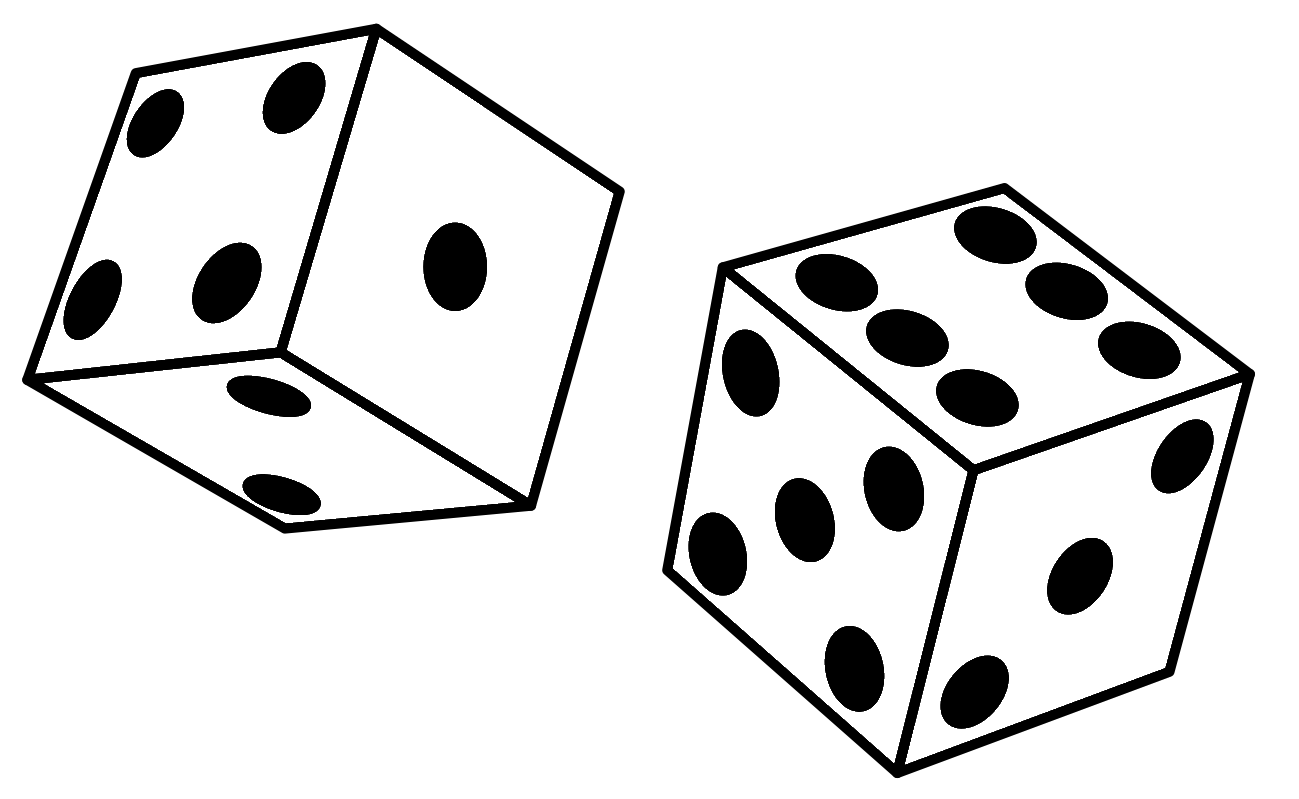
Let’s take rolling dice as an example. Probability space can be applied here to determine the probabilities of rolling, let’s say, a 6 on the next roll, or how likely are we to end up with odd number.
Probabilities of getting 3
- Where:
\(\Omega = \{1,2,3,4,5,6\}\) - Dice has 6 sides so it contains all the possible outcomes
\(\mathcal{F} = \{\emptyset, \{3\}, \{1,2,4,5,6\}, \Omega\}\) - The event we’re interested in. (\(\emptyset\)) - Indicating that no outcome satisfies the condition (\(\mathbb{P}(\emptyset) = 0\)). \(\{3\}\) - The outcome is 3. \(\{1,2,4,5,6\}\) - The outcome is not 3. \(\Omega\) - The outcome is always true (\(\mathbb{P}(\Omega) = \frac{|\Omega|}{|\Omega|} = \frac{6}{6} = 1\))
So, the result is \(\frac{1}{6}\), which is ~0.17 = ~16.7%